Define the series before creating appointments
Record the appointment type, duration, therapist, location, room or equipment, recurrence pattern, starting date, end condition and review owner. Distinguish requested holds from confirmed appointments. Ask whether the series has a maximum number of visits or a review point and how staff see that limit. Keep the clinical plan and payer evidence linked but separate from the booking pattern. This guide does not prescribe a treatment frequency or duration. Those decisions belong to the responsible professionals and the requirements applicable to the patient and service.
Make the scope of every edit explicit
Test three different commands: change this occurrence, change this and future occurrences, and change the whole series. Before confirming, ask the software to show which dates, resources and notices will be affected. A cancellation should not silently erase evidence of the original appointment or close an unrelated balance. A therapist change may need a different review from a time change. Record who may approve the action, how staff can understand the previous state and what recovery is available if the wrong scope is selected.
Use one fictional series to test five exceptions
Imagine a twice-weekly series over four weeks, solely as a software test and not a recommended plan of care. Cancel one visit for a closure, move another to an occupied room, record a therapist absence, request an extra visit and stop future bookings. Compare the original eight requested occurrences with the final confirmed, cancelled and review-needed states. Do not treat the resulting appointment count as a covered-visit balance or assume that a cancellation restores an authorisation. The useful result is a traceable explanation of what happened to each occurrence.
Keep plan-of-care and payer review visible
For Medicare outpatient therapy, CMS describes plan-of-care elements including type, amount, frequency and duration; use the current manual and qualified billing review for the exact setting and situation. Do not copy those requirements into a universal rule for every commercial payer, state or self-pay practice. Ask how the system records the applicable review dates, supporting document version and responsible role without letting a recurring slot imply that the review passed. A schedule warning can support staff work, but it does not determine coverage or automatically establish the right to bill.
Review notices as a separate workflow
Define who receives each change, which channel is appropriate and what happens when delivery fails. Preview one-occurrence and future-series notices to ensure they describe the right dates. HHS permits appointment reminders under HIPAA and also explains safeguards for messages and reasonable confidential-communication requests. That is not blanket permission for every channel or marketing message. The practice must review its actual legal and operational requirements. Ask whether a provider accepted a message, whether delivery was confirmed and who follows up; those are different states.
Reconcile attendance, documentation and billing
A booked visit, attended visit, completed note and posted charge are different records. After the fictional changes, follow a completed occurrence to its documentation and invoice, then inspect a cancelled and a missed occurrence. Apply only the practice’s verified policies; do not invent a cancellation fee or payer rule during testing. Check how staff identify duplicate visits, unfinished notes and charges that no longer match the service record. Keep the clinical and financial correction history understandable instead of deleting an appointment merely to make a dashboard balance.
Choose a bounded acceptance decision
Finish the demonstration with a table showing the expected result, observed result, unresolved exception and next owner for each scenario. Include front-desk and practitioner perspectives and test on the devices used by the team. Mark unavailable capabilities explicitly. Flor’s public demo uses fictional records and is not a live scheduling, patient-record or payment service. Confirm the exact hosted product scope and rollout evidence with the team before using real appointments. Bring the exception worksheet to a guided review rather than entering patient details into public chat or an enquiry form.
Reconcile a bounded fictional series
Use an eight-occurrence fictional series, not a recommended treatment plan. Introduce a closure, room conflict, therapist absence, extra request and future-series stop. Reconcile every occurrence and keep clinical, payer, reminder and billing reviews separate. Record the expected result, observed result and next owner.
| Check in the demonstration | Evidence to record |
|---|---|
| Single versus future change is explicit | Describe the observed result using fictional data. |
| Requested, confirmed and cancelled visits reconcile | Record the role, exception and any manual work required. |
| Review dates and notices retain an owner | Agree on pass, follow-up or unavailable before rollout. |
Continue with appointment scheduling software for therapy practices and practice billing and payment workflows to test the connected steps. The interactive Flor demo provides fictional examples for the discussion.
Questions for a US practice
Separate self-pay invoicing, superbills and electronic claims in your requirements. A working invoice does not establish payer connectivity. Ask for USD pricing, define staff and recipient access, and test the exact state, discipline and payer workflows relevant to your practice.
Where HIPAA applies, review the actual cloud services, responsibilities and agreements involved. HHS cloud-computing guidance is a starting point for those questions. A software label is not evidence that a particular clinic configuration satisfies its obligations.
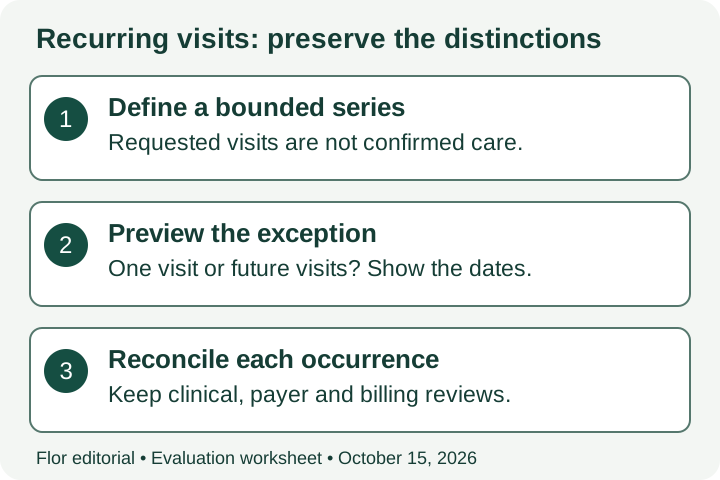
Recurring-visit exception worksheet
Use fictional visits. Record requested, confirmed, changed, cancelled and review-needed states separately; do not substitute calendar counts for coverage or clinical decisions.
| Review case | Scope to test | Evidence and limit to record |
|---|---|---|
| One occurrence | Keep other visits unchanged | Original date, reason, approver and correct notice. |
| Future occurrences | Preview every affected date | Effective date, conflicts, end rule and retained earlier history. |
| Review needed | Do not imply confirmation | Responsible clinician or billing role, required evidence and next action. |
| Completed occurrence | Reconcile connected records | Attendance, note, invoice and corrections remain distinct. |
Primary sources checked October 15, 2026: CMS Medicare Benefit Policy Manual, Chapter 15, sections 220–230, HHS appointment-reminder guidance and HHS message safeguards and confidential-communication requests. Medicare guidance is not a universal rule for every payer or setting; reminder permission is not blanket permission for any message or channel.
A few common questions
Does a recurring booking confirm insurance coverage?
No. Scheduling, clinical documentation, payer authorisation and payment are separate decisions and records. Verify the requirements for the actual payer and service.
Is the example’s twice-weekly pattern clinical advice?
No. It is fictional test data used to exercise software exceptions, not a recommended treatment plan or billing instruction.
Prepared for clinic owners in United States. Updated . These guides support product evaluation and do not replace professional or legal advice.